
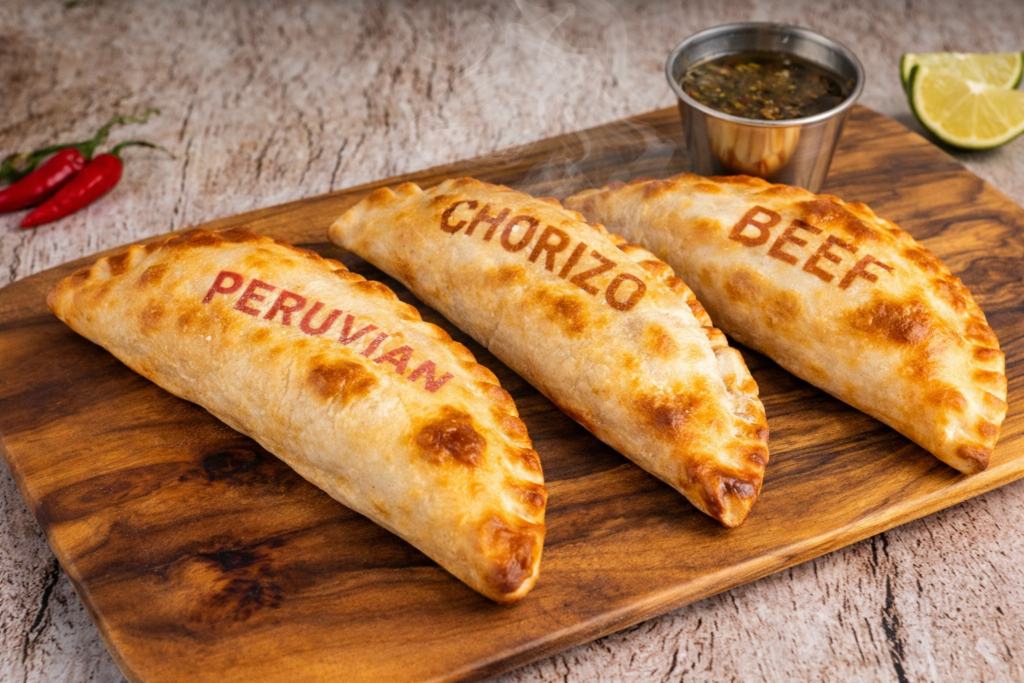
At Los Andes in Jacksonville, the menu draws from two of the richest empanada traditions on the continent: Peruvian and Argentinian. But to truly appreciate what makes each style special, it helps to know how they differ – and why those differences matter.
Argentine Empanadas
Dough: Enriched wheat dough with egg and milk – slightly golden, glossy from egg wash, and tender rather than flaky.
Filling: Seasoned ground beef, sliced onion, hard-boiled egg, green olive, and sometimes raisins. The balance of savory, briny, and slightly sweet is distinctly Argentine.
Cooking method: Baked, though fried versions exist in the north.
Distinguishing detail: The filling varies by province – Tucumán uses hand-cut beef, Salta adds potato, Córdoba uses white sauce. The repulgue (crimped edge pattern) traditionally signals the filling inside.
Peruvian Empanadas
Dough: Thin, bread-like dough similar to a soft pizza or calzone crust – lighter than Argentine dough, slightly chewier.
Filling: Ground beef with onion, hard-boiled egg, and black olives – seasoned with soy sauce for a deeper, umami-forward flavor that sets it apart from other South American versions.
Cooking method: Baked, finished with egg wash, served with fresh lime wedges.
Distinguishing detail: The soy sauce in the filling reflects Peru’s strong Chinese immigrant influence on its cuisine (chifa tradition).
Peruvian empanadas are one of the two styles you’ll find on the menu at Los Andes, made fresh daily at both locations.
Colombian Empanadas
Dough: Cornmeal masa (masarepa) – naturally gluten-free, golden after frying, with a distinct crunch that wheat-dough empanadas can’t replicate.
Filling: Seasoned beef or pork with potato, sometimes rice, onion, garlic, and bell pepper.
Cooking method: Deep-fried.
Distinguishing detail: Always served with ají – a thin, spicy Colombian dipping sauce. Without the ají, you’re only getting half the experience.
Chilean Empanadas
Dough: Wheat-based, similar to Argentine but often rolled thicker and larger.
Filling: The iconic filling is pino – minced beef, onion, black olives, raisins, and a quarter of a hard-boiled egg.
Cooking method: Baked, though fried seafood empanadas are also popular in coastal areas.
Distinguishing detail: Chilean empanadas are noticeably larger than Argentine ones – closer in size to a small calzone.
Mexican Empanadas
Dough: Two traditions – wheat pastry dough and corn masa dough depending on the region.
Filling (savory): Chorizo, picadillo, black beans with cheese, or chicken with salsa verde.
Filling (sweet): Sweet potato with piloncillo, guava, or pumpkin.
Cooking method: Fried or baked depending on region.
Distinguishing detail: Mexican sweet empanadas are as common as savory ones, especially around Día de los Muertos.
Spanish Empanada Gallega
Dough: Wheat dough, sometimes with a touch of white wine or lard – similar in texture to soft bread.
Filling: Tuna with onion, bell pepper, and tomato is the classic. Octopus, sardine, and pork versions are also traditional in Galicia.
Cooking method: Baked in a large rectangular or round pan – this is a pie, not a hand pastry.
Distinguishing detail: Empanada gallega is the ancestor of most Latin American empanadas. Spanish colonizers brought the format to the Americas; each country adapted it with local ingredients.
Bolivian Salteñas
Dough: Wheat dough, slightly sweet and tinted golden.
Filling: A juicy stew of beef or chicken with potato, peas, carrots, hard-boiled egg, and olives – the filling is deliberately soupy.
Cooking method: Baked.
Distinguishing detail: Salteñas are traditionally a breakfast food, sold from street stalls in the morning.
Ecuadorian Empanadas
Dough: Two distinct traditions – empanadas de morocho use ground corn; empanadas de viento use wheat dough.
Filling: Cheese is the most common filling, especially in empanadas de viento, which are sprinkled with sugar after frying.
Cooking method: Mostly fried.
Distinguishing detail: Empanadas de viento literally means “empanadas of wind” – they puff up dramatically during frying because the filling is minimal.
Puerto Rican Empanadas (Empanadillas)
Dough: Simple wheat pastry dough – slightly flaky, thin-walled.
Filling: Picadillo (seasoned ground beef with olives and capers) is the classic, though chicken, seafood, and cheese versions are equally popular.
Cooking method: Deep-fried until very crispy and golden.
Distinguishing detail: Thinner-walled and crunchier than their South American counterparts.
Filipino Empanadas
Dough: Wheat flour dough, slightly sweet.
Filling: Ground beef or pork with potato, onion, and raisins. The Ilocos region has a distinct version with green papaya, mung beans, and Vigan longganisa.
Cooking method: Fried.
Distinguishing detail: The Philippines received empanadas through Spanish colonial rule – the picadillo filling is almost identical to its Latin American cousins.
El Salvador: Empanadas de Plátano
Dough: Ripe plantain mashed into a soft, sweet dough – no wheat at all.
Filling: Vanilla custard or refried beans.
Cooking method: Fried, then rolled in sugar.
Distinguishing detail: These are unambiguously dessert. The plantain dough is naturally sweet, the custard filling is sweet, and the sugar coating is sweet.
Quick Comparison: Types of Empanadas by Country
| Country | Dough | Classic Filling | Cooked | Size |
|---|---|---|---|---|
| Argentina | Enriched wheat | Beef, egg, olive | Baked | Medium |
| Peru | Bread-like wheat | Beef, olive, soy sauce | Baked | Medium |
| Colombia | Cornmeal masa | Beef and potato | Fried | Small |
| Chile | Wheat | Pino (beef, olive, raisin, egg) | Baked | Large |
| Mexico | Wheat or masa | Chorizo, beans, or sweet potato | Fried or baked | Medium |
| Spain (Galicia) | Wheat (bread-style) | Tuna, pepper, onion | Baked (pie format) | Large pie, sliced |
| Bolivia | Wheat (slightly sweet) | Beef stew with potato and peas | Baked | Medium |
| Ecuador | Corn or wheat | Cheese | Fried | Small–medium |
| Puerto Rico | Thin wheat pastry | Picadillo | Fried | Small–medium |
| El Salvador | Ripe plantain | Vanilla custard | Fried, sugared | Small |
| Philippines | Wheat (slightly sweet) | Picadillo or Ilocos sausage | Fried | Medium |
Empanadas at Los Andes Jacksonville
Los Andes serves empanadas rooted in the two traditions that arguably produce the best baked versions on the continent: Peruvian and Argentinian. Both are baked fresh daily at both Jacksonville locations – not frozen, not reheated.
The full empanada menu includes beef, chicken, chorizo, lomo saltado, Peruvian chicken, vegan, ham and cheese, caprese, onion and cheese, potato and cheese, corn, cheese, and dessert varieties. The lomo saltado empanada is worth singling out – Peru’s most iconic stir-fry enclosed in a baked crust. Find your nearest location and see the full menu: Empanadas in Jacksonville, FL.
- Atlantic Blvd: 10916 Atlantic Blvd Unit 8, Jacksonville, FL 32225
- Marsh Landing (Jacksonville Beach area): 335 Marsh Landing Parkway, Jacksonville Beach, FL 32250
Frequently Asked Questions About Types of Empanadas
What is the difference between Argentine and Peruvian empanadas?
Argentine empanadas use an enriched wheat dough with egg and milk, giving them a glossy, tender crust. The filling is typically beef with hard-boiled egg, green olive, and sometimes raisins, seasoned with cumin and paprika. Peruvian empanadas use a lighter, bread-like wheat dough and a beef filling seasoned with soy sauce – a nod to Peru’s chifa (Chinese-Peruvian) culinary tradition. Both are baked, but the flavor profiles are distinct. At Los Andes in Jacksonville, you can taste both side by side. See our Argentinian restaurant in Jacksonville and Peruvian restaurant in Jacksonville pages to plan your visit.
Are Colombian empanadas the same as regular empanadas?
No – Colombian empanadas are made with cornmeal masa (masarepa), not wheat dough, making them naturally gluten-free and giving them a completely different texture: crispy and crunchy from deep frying. The filling is typically seasoned beef with potato, served with ají dipping sauce. They are smaller than South American wheat-dough versions.
What is an empanada gallega?
Empanada gallega is a large savory pie from the Galicia region of northwestern Spain, made with a wheat dough similar to bread and filled with tuna, onion, and bell pepper (the most traditional version). Unlike Latin American empanadas, it is not a hand-held individual pastry – it is baked as a full rectangular or round pie and sliced into portions. Empanada gallega is the historical ancestor of most Latin American empanada styles.
Where can I find empanadas near me in Jacksonville, FL?
Los Andes Restaurant has two Jacksonville-area locations serving freshly baked Peruvian and Argentinian empanadas daily. The Atlantic Blvd location is at 10916 Atlantic Blvd Unit 8, Jacksonville, FL 32225. The Marsh Landing location is at 335 Marsh Landing Parkway, Jacksonville Beach, FL 32250. Both offer dine-in and takeout, with delivery available through DoorDash and Uber Eats.
What types of empanadas does Los Andes serve?
Los Andes Jacksonville serves baked empanadas in these varieties: beef, chicken, lomo saltado, Peruvian chicken, chorizo, ham and cheese, caprese, onion and cheese, potato and cheese, corn, cheese, vegan, breakfast, and dessert. The empanadas are made in-house and baked fresh daily at both the Atlantic Blvd and Marsh Landing locations.
Are empanadas fried or baked?
It depends on the country and style. Argentine, Peruvian, and Chilean empanadas are traditionally baked. Colombian, Puerto Rican, and Ecuadorian empanadas are typically fried. Los Andes bakes all of its empanadas – the result is a flaky, golden crust without the heaviness of frying.